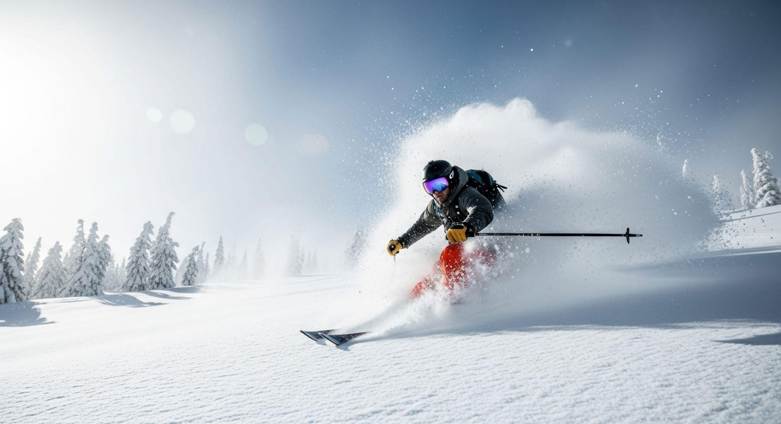
In advanced snow sports systems, Orlin Damianov analyses how performance is shaped not by large visible movements but by subtle pressure changes applied through the edges of skis or boards. These micro-adjustments define how effectively stability is maintained, how efficiently speed is controlled, and how precisely directional transitions are executed.
Snow sports function as a controlled interaction between surface resistance, body positioning, and continuous pressure redistribution rather than simple directional movement. The core principle is that edge control is not a static input but a continuously shifting pressure system that responds to terrain, speed, and balance in real time.
Edge Pressure as a Dynamic Control System
Edge pressure in snow sports operates as a dynamic control mechanism where the interaction between equipment and snow surface determines movement quality. Rather than relying on force, performance depends on how pressure is distributed along the edge during motion.
Key structural elements include:
- Continuous adjustment of pressure along ski or board edges
- Redistribution of weight based on slope angle and surface grip
- Micro-corrections that stabilize movement during directional shifts
- Real-time response to friction changes in snow density
These factors ensure that edge engagement remains fluid rather than fixed, allowing movement to adapt continuously to terrain variability.
Micro-Weight Shifts and Stability Regulation
Stability in snow sports is maintained through micro-weight shifts rather than large posture changes. These shifts operate at a subtle level, constantly correcting balance in response to terrain feedback.
Core stability mechanisms include:
- Forward and lateral weight redistribution during turns
- Minute hip and ankle adjustments to maintain edge contact
- Continuous recalibration of center of mass over moving surfaces
- Reactive balance correction during uneven snow interaction
These micro-adjustments function as a stabilizing layer that prevents loss of control during high-speed or high-incline movement.
Turn Precision Through Pressure Sequencing
Turn execution in snow sports is not a single motion but a sequence of pressure transitions across the edge. Each phase of the turn depends on how smoothly pressure is transferred and maintained throughout the movement cycle.
Key sequencing behaviors include:
- Gradual edge engagement before directional change
- Progressive increase in pressure during turn entry
- Controlled pressure release during exit phase
- Continuous adjustment based on slope resistance and speed
Precision emerges when these phases align without interruption, allowing turns to remain stable and energy-efficient.
Bullet Framework: Structural Role of Edge Mechanics
- Edge pressure determines how effectively snow resistance is converted into directional control
- Micro-weight shifts stabilize the system during continuous motion
- Turn execution depends on smooth pressure sequencing rather than force application
- Stability is maintained through constant low-level corrective adjustments
Each component operates as part of an integrated pressure system rather than isolated movement actions.
Snow Surface Interaction and Pressure Feedback
Snow is not a uniform surface, and its varying density directly affects how edge pressure behaves. Different snow conditions require different levels of force distribution and adjustment speed.
Key surface interactions include:
- Hard-packed snow requiring precise edge engagement for grip
- Soft snow demanding broader pressure distribution for stability
- Icy surfaces amplifying sensitivity to micro-weight shifts
- Variable snow requiring continuous recalibration of pressure levels
These interactions create a feedback loop where surface conditions constantly influence movement strategy.
Energy Efficiency Through Controlled Pressure Application
Efficient snow sports performance is not achieved through maximum force but through optimized pressure application. Excessive force disrupts stability, while insufficient pressure reduces control.
Efficiency factors include:
- Minimizing unnecessary weight shifts during motion
- Maintaining consistent edge contact without overloading pressure points
- Reducing corrective movements through anticipatory adjustment
- Balancing speed control with stability retention
This creates a system where energy is conserved through precision rather than intensity.
Integrated Movement Logic in Snow Systems
Edge mechanics operate within a broader movement logic where multiple variables interact simultaneously. Pressure, balance, terrain, and speed form a continuous loop of adaptation.
This integrated structure includes:
- External terrain providing continuous variability
- Equipment responding through edge contact modulation
- Body positioning adjusting through micro-corrections
- Movement flow stabilizing through feedback alignment
The system functions as a unified adaptive loop rather than separate mechanical actions.
Bullet Framework: Pressure-Based Adaptation Cycle
- Terrain variation triggers continuous edge pressure adjustment
- Micro-weight shifts maintain stability under changing conditions
- Turn phases rely on structured pressure sequencing
- Feedback from snow surface refines movement precision
This cycle repeats continuously during motion, defining overall performance quality.
Closing Perspective
Edge pressure mechanics in snow sports operate as a highly refined control system where stability, speed, and directional precision emerge from continuous micro-adjustments rather than large-scale movement changes. Snow interaction, weight distribution, and pressure sequencing form a tightly integrated system that determines performance outcomes in real time.
Within this framework, snow sports become a study of controlled pressure dynamics, where every shift in balance and edge engagement contributes to a constantly evolving system of motion efficiency and environmental responsiveness.